
The Good, The Bad, and The Ugly of Artificial Intelligence: A Wake-Up Call for Business Leaders
AI Isn't Coming for Your Job. It's Coming for Your Business Model.
Artificial Intelligence is no longer a future technology. It's here, embedded into the tools we use every day, used by your staff and even dominating normal search, influencing vital business decisions, generating work and marketing content, automating workflows, analyzing data, and reshaping how work gets done. As much as even I have major doubts, fear of error, and even distrust in agentic AI, I have come to the realization that it is already here and I personally along with our top business leaders need to drive leadership and positioning as we approach with caution and arm the industry with transparency and knowledge.
I am not the only one...many business leaders remain in one of two camps: the skeptics who believe AI is overhyped or flawed with bad data or taking away jobs, or the enthusiasts who believe it is a silver bullet, is the holy grail, and overly trusting it as accurate.
Both are wrong.
The reality is that AI represents one of the most significant shifts in business technology since the rise of the Internet. It offers extraordinary opportunities, introduces serious risks, and demands a new level of leadership accountability. Humans and AI will need to work together!
The future belongs neither to organizations that fear AI nor those that blindly trust it. It belongs to those that understand it. Playing catch up sucks, but we must continue to educate ourselves as business leaders to be prepared for the train that is coming FAST!
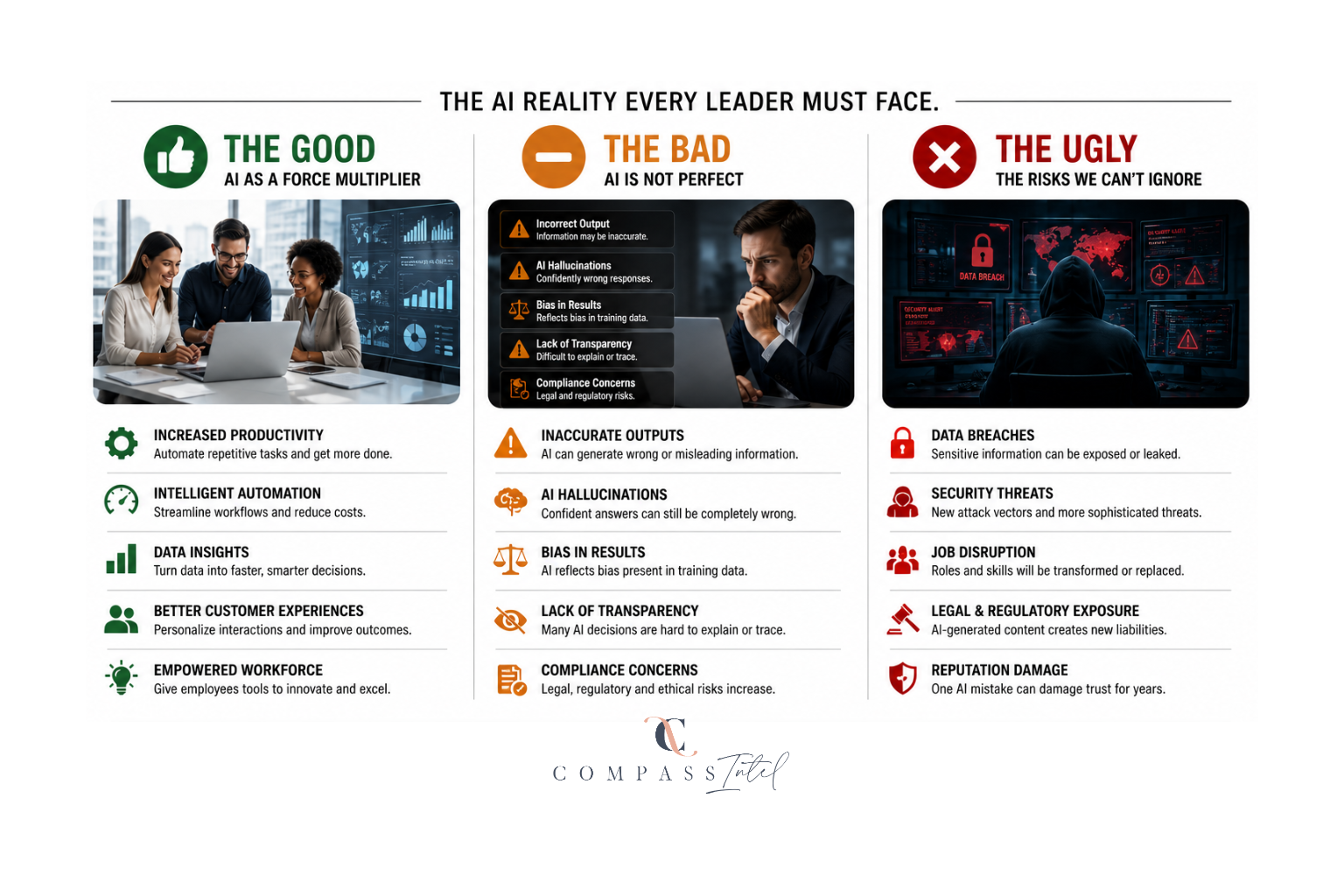
The Good: AI as a Force Multiplier
When implemented strategically, AI has the power to dramatically improve productivity, efficiency, and decision-making. It can even put aside the mundane, the tedious, the repetitive, and open doors for our PEOPLE to focus on what matters the most...a reprioritization of work duties, operations, and processes.
Organizations and workers are already leveraging AI to:
Automate repetitive administrative tasks
Accelerate customer service and support
Generate reports, proposals, and communications
Analyze large datasets in seconds
Enhance forecasting and planning
Improve operational workflows
Increase employee productivity
Search, learn, and summarize
For many organizations, AI acts as a digital assistant capable of performing hours of work in minutes. The result is not simply cost savings. It is speed. In today's economy, speed creates competitive advantage but again we all have access to this AI goodness but do we all really know how to use it?
The organizations and workforce that learn faster, respond faster, and innovate faster will outperform those still relying on traditional processes. The younger generation and those graduating from colleges, are becoming avid users of agentic AI tools either already inherit in software and applications being used, or are trying out a myriad of AI tools out there for specific tasks, to study and learn, to get work done, and so much more.
The Bad: AI Can Create a False Sense of Intelligence
One of the greatest misconceptions surrounding AI is that it is intelligent.
It is not.
AI is remarkably capable at identifying patterns, generating content, and predicting likely outcomes. However, it does not possess human judgment, critical thinking, ethics, or contextual understanding. In some cases, the creativity it produces is lacking in the personal human touch or the decades long experience that humans have as an advantage. AI however can:
Generate inaccurate information
Produce convincing but incorrect conclusions
Fabricate sources and references
Reflect bias present in training data
Create compliance and legal concerns
Compute basic math incorrectly
Create risk or introduce greater risk and failure
Provide bad actors an advantage or increase fraudulent activities
Hallucinate known information, facts, data, etc.
Many employees are already using AI-generated outputs without verification, assuming that because the response sounds authoritative, it must be accurate. Bad information in, bad information out. Bad data in, bad data out. Do we know what data these AI systems are being training on? Do we trust it as accurate and unbiased?
This is a dangerous assumption.
Organizations must establish governance frameworks that treat AI as an assistant; not an authority. That is where humans come in...
Trust, but verify. Humans will be the authority over AI output, we will be the managers of AI output, we will oversee operations and functions being trusted by AI. Of course there will be the exceptions, where we are training private models using our own company data, training manuals, live real-time data, etc. Again, humans will be involved as they may be alerted, need to perform a specific action, or need to approve or greenlight.
The Ugly: The Security and Workforce Risks Nobody Wants to Discuss
The most significant AI conversations are often happening in the wrong places. Leaders are discussing productivity gains while overlooking security risks.
Employees are uploading sensitive corporate information into public AI platforms every day. Proprietary data, customer information, financial records, strategic plans, and intellectual property are increasingly being shared with systems outside traditional security controls.
This introduces new questions:
Where is the data going?
How is it being stored?
Who can access it?
What regulatory risks exist?
What happens when AI-generated content becomes part of a legal or compliance process?
At the same time, AI is changing the workforce itself. Many roles will not disappear entirely, but they will be transformed or reprioritized.
The employees most at risk are not necessarily those with the least experience. They are those who fail to adapt. Of course jobs with special human skills or trades are expected to be less impacted or not affected at all by AI in terms of job loss.
Future high-performing employees will combine human expertise with AI capabilities. They will know how to ask better questions, evaluate outputs, validate information, and leverage AI as a strategic tool.
AI literacy is quickly becoming a business necessity.
Operations: The Largest Opportunity Most Organizations Are Missing
While much of the public conversation focuses on ChatGPT, Claude, Gemini, Grok, Perplexity, etc. and content generation, the greatest long-term impact of AI may occur behind the scenes.
Operations. AI and machine learning is the engine behind:
Intelligent workflow automation
Predictive maintenance
Supply chain optimization
Resource allocation
Financial forecasting
Customer journey management
Digital twins and operational dashboards
Infrastructure intelligence
The organizations that successfully integrate AI into operational processes will create efficiencies that competitors may struggle to match. The question is no longer whether AI can automate tasks. The question is whether your competitors are already automating them.
Leadership's New Responsibility
AI is not an IT initiative. It is not a marketing initiative. It is not a productivity tool. It is a business transformation initiative. Every executive team should be asking:
What is our AI strategy?
What are our governance policies?
How are we protecting sensitive information?
Which business processes can be automated?
How are we training employees?
How are we measuring AI-driven outcomes?
What ethical and compliance safeguards are in place?
Organizations that fail to answer these questions risk falling behind those that do.
Final Thoughts From a 25+ year Tech Analyst, Thought Leader, Researcher of B2B
The AI revolution will create winners and losers. The winners will not necessarily be the organizations with the largest budgets or the most sophisticated technology. They will be the organizations with leaders who understand both the promise and the peril of artificial intelligence.
The good is increased productivity, innovation, and growth. The bad is misinformation, overreliance, risk, and poor decision-making. The ugly is the security, governance, fraud, and workforce disruption many organizations still refuse to acknowledge.
The time for experimentation is ending. The time for enterprise and business AI leadership and knowledge is now.
Artificial Intelligence is no longer a technology discussion...it is a business discussion. As AI becomes embedded into operations, customer engagement, workforce productivity, and decision-making, boards and executive leadership teams have a responsibility to move beyond experimentation and ask tougher questions.
1. What Happens If Our Competitors Adopt AI Faster Than We Do?
2. Do We Have an AI Governance and Security Framework in Place?
3. Which Roles and Processes Are Being Transformed by AI?
4. How Will We Measure AI Success?
5. Are We Preparing for the AI We Will Have in Three Years, Not the AI We Have Today?
The most important AI question is not, "Should we use AI?" That question has already been answered. The real question is: How do we lead responsibly, securely, and strategically in a world where AI becomes part of every business process, every employee workflow, and every customer interaction?
The answer to that question may determine which organizations lead the next decade...and which are left behind.
Prepared and Written by: Stephanie Atkinson, MBA founder of Compass Intelligence and vMarque

A few sources for interesting reading:
10 famous AI disasters - https://www.cio.com/article/190888/5-famous-analytics-and-ai-disasters.html
Deloitte was caught using AI in $290,000 report to help the Australian government crack down on welfare after a researcher flagged hallucinations - https://fortune.com/2025/10/07/deloitte-ai-australia-government-report-hallucinations-technology-290000-refund/
Poor leadership, process failures are sinking AI projects: IBM exec - https://www.cfodive.com/news/poor-leadership-process-failures-sinking-ai-projects-ibm-exec/821062/
